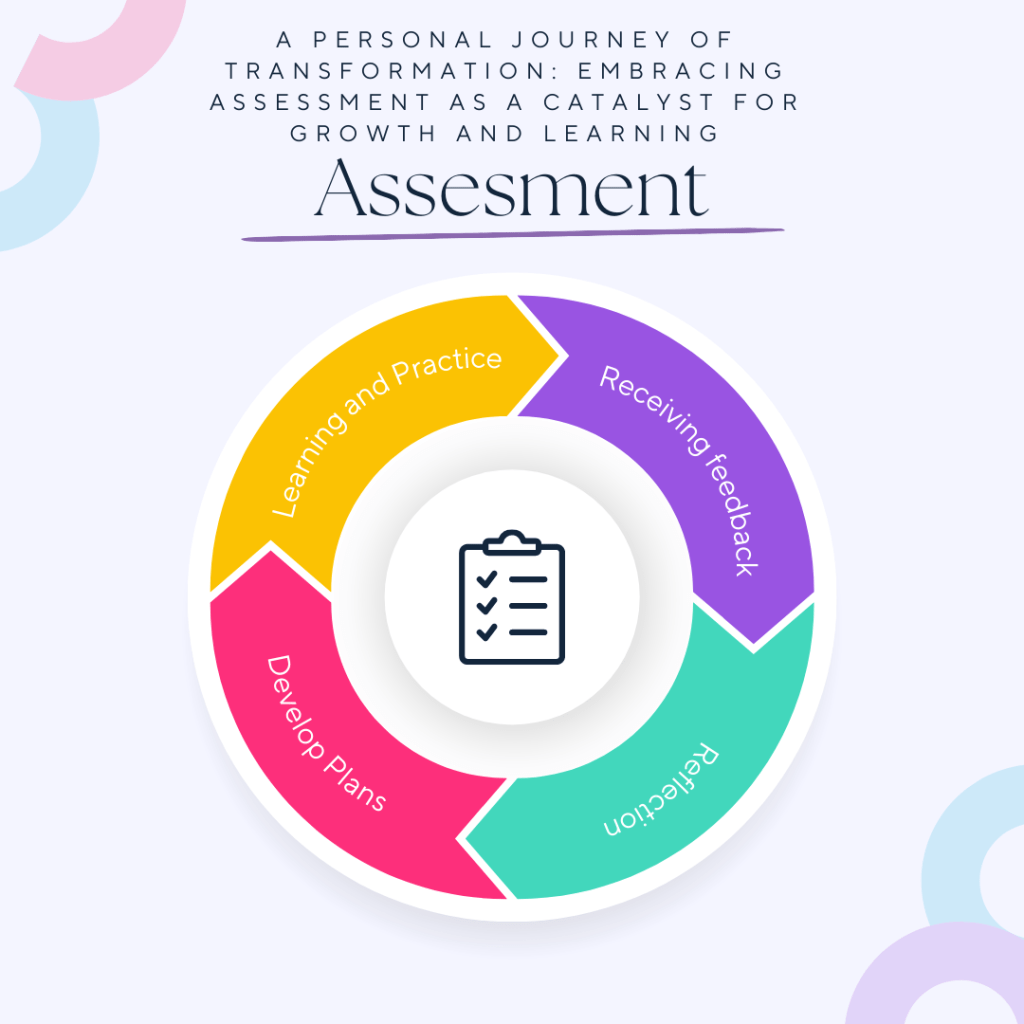
In my pursuit of comprehending assessment purposes and alignment, I’ve undergone a transformative journey that profoundly influenced my beliefs, approaches, and values regarding assessments. This newfound understanding has revealed the broader significance of assessments as dynamic tools for nurturing growth and learning. Before, I mostly viewed assessments as mere grading tools to judge my performance. Now, I recognize their deeper purpose in measuring progress and catalyzing personal development. This change has empowered me, shifting my perception from fear to embracing assessments as supporters of my learning journey.
This understanding has led me to adopt student-centered and formative assessment practices. I prioritize seeking continuous feedback and engaging in self-reflection to understand my strengths and areas for improvement better. This proactive approach has boosted my ability to direct my own learning and growth. I’ve also grown to value metacognition and self-assessment. Analyzing my learning processes enhances my autonomy as a learner, fostering a stronger sense of responsibility in shaping my educational path.
Moreover, my focus now extends beyond mere content knowledge to appreciate broader learning outcomes like critical thinking and problem-solving. This shift broadened my perspective on the diverse aspects of learning. Furthermore, understanding how assessments can cater to diverse needs deepened my commitment to creating inclusive and equitable learning environments. Advocating for assessments that consider individual differences, I strive to foster an environment where all learners can thrive.
My journey of understanding assessment purposes and alignment has been transformative. I now see assessments as powerful tools for growth, not intimidating evaluations. Embracing these changes, I continue on a path of self-discovery, empowerment, and lifelong learning. As I navigate the educational landscape, I’m confident these newfound beliefs, approaches, and values will guide me to become a proactive and empowered learner.
In my personal experience, while taking my executive MBA, I have come to appreciate the value of assessment frameworks in the educational setting. These frameworks provide a structured approach and guidelines for designing and implementing assessments. They have allowed me to have a more logical and scientific perspective when interpreting observations within the assessment process. With the rapid advancements in technology and the ever-changing world, assessment frameworks have evolved to incorporate new tools and approaches. Through the use of data analysis tools, I have been able to gain a deeper understanding of my own strengths and weaknesses as a learner. This has provided valuable insights for educators to make informed decisions about instructional strategies and interventions to support my growth. The introduction of digital portfolios has been a game-changer for me. It has allowed me to showcase my work and reflect on my growth over time. This holistic approach to assessment has given me a sense of pride and accomplishment as I can see how far I have come in my learning journey.
Additionally, the availability of learning analysis tools and assessment apps has empowered me to take ownership of my learning. Through self-assessment and receiving instant feedback, I have been able to develop important skills such as self-reflection and metacognition. These tools have also allowed educators to personalize my learning experience and provide targeted guidance and support when needed. As I reflect on my educational journey, I realize the importance of contextualized assessments. Assessments that take into account my unique background, interests, and learning style have been the most meaningful and effective. They have made the assessment process more relevant and engaging, allowing me to connect my learning to real-world experiences.
Overall, assessment frameworks have provided me with a structured and comprehensive approach to assessing my learning. The integration of technology tools and personalized approaches has greatly enhanced my educational experience. I am grateful for the opportunities these frameworks have provided, enabling me to grow and succeed academically.
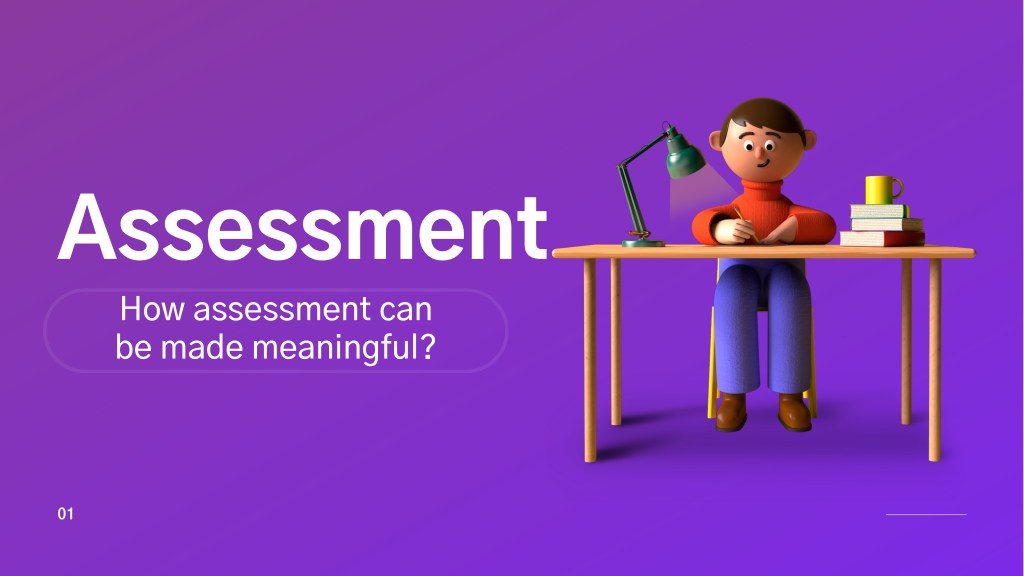
In my personal experience, I have found that when it comes to making assessments meaningful and enjoyable for students, considering different strategies can greatly enhance the effectiveness of the assessment process. By incorporating various approaches, educators can create an environment where assessments become more than just a measure of performance, but a tool for promoting engagement and enjoyment in learning. One such strategy is aligning assessments with students’ interests and real-world applications. When students can see the relevance and purpose of what they are learning, assessments take on a deeper meaning and become more enjoyable (Hattie & Timperley, 2007). By connecting the content and skills being assessed to real-life situations or their own personal interests, students are more likely to engage and find value in the assessment process.
Another effective strategy is providing choice and autonomy in assessments. Allowing students to have a say in selecting topics or formats that align with their interests and learning preferences empowers them and increases their motivation (Deci & Ryan, 2000). When students have a sense of control and ownership over their assessments, they are more likely to be invested in the learning process and find the assessments personally meaningful. Incorporating elements of gamification and technology can also enhance the enjoyment and meaningfulness of assessments. Gamifying assessments by introducing game-like elements, such as challenges, rewards, and progress tracking, can create a sense of excitement and engagement (Aldemir & Simsek, 2020). Technology tools and platforms can be utilized to make assessments more interactive and objective, providing students with a more enjoyable and immersive experience.
Providing effective feedback is another crucial aspect of making assessments meaningful and enjoyable. Timely and constructive feedback that focuses on growth and improvement rather than just assigning grades helps students understand their progress and areas for development (Black & Wiliam, 1998). By emphasizing feedback as an opportunity for learning and growth, students are more likely to view assessments as valuable learning experiences rather than simply as a means to receive grades. Furthermore, collaborative assessments, where students work together in groups or engage in peer feedback, can greatly enhance the enjoyment and meaningfulness of assessments. Collaborative activities promote teamwork, communication, and shared responsibility, creating a supportive and engaging learning environment (Slavin, 2014). Students can learn from and with each other, actively participate in problem-solving, and develop essential interpersonal skills.
By implementing these strategies, educators can create assessments that not only effectively evaluate student learning but also inspire and engage students in their educational journey. Meaningful and enjoyable assessments not only promote deeper learning and understanding but also foster students’ intrinsic motivation and desire to continue their learning journey.
What are we thinking after we’ve had some experiences and learned some lessons in life? What are some of the things you need to keep in mind if you want a career in education someday? Are you considering positioning yourself as a leading educator in the industry today? Some of the questions that need to be answered while one is studying to become a teacher in the future. To what extent, however, have we been able to cultivate all of the lessons that we have encountered up to this point? Did we just teach ourselves everything we need to know, or did we somehow study more than we normally would in order to understand a lot of the theories that we cover in our classes?
No matter what the questions are, the only way for us to know for certain the answers is if we have learned enough to put these skills into practice in the role of an educator someday. Both education and psychology devote a significant amount of their research to the study of the learning process. Learning requires a variety of actions on our part, depending on how we wish to engage in the process of acquiring the information, experiences, and knowledge that we seek. Learning is a process that requires effort and can influence both our actions and the way we perceive the world around us. Of course, there are a lot of obstacles to overcome, but learning is made much simpler by the fact that we have to deal with a variety of problems. There are a number of challenges, some of which include cognitive, environmental, and motivational issues. In conclusion, education is not a one-way street; in order to learn, we not only need to interact with other people and our environment, but we also need to feel the changes that take place within us as we continue to learn and assimilate new information.
It did not occur to me a few years ago that I would one day be writing this ejournal and going through another four years of schooling by enrolling in the Bachelor of Education Studies program at UPOU. I was aware that this would be a difficult task for me to complete because, for the past 30 years, I have been actively engaged in the real world, dealing with real issues and problems in both my professional and personal life. I have come to the conclusion that it does not really make a difference whether you are young or old, a student or working when it comes to learning new things even in theories and new concepts. Not only does it stimulate your thirsts to gain more knowledge, but it also somehow proves the theories you are studying to be true to your experience. When you are young, it can be very challenging to comprehend that a person can learn and mature through the experiences that they have, learn from their environment and interaction with different people, and learn from another person who is more knowledgeable than you.
Now I understand why there are so many different learning theories, for instance, given the number of psychologists and scientists that have contributed to their development. Each person is one of a kind and possesses their own cultural heritage in addition to having their own distinct social interactions, both of which are indicative of how they process learning. My viewpoint is that education is open to all people, has no upper age limit, and does not mandate the use of any specialized materials or equipment. It is simply coming to terms with the fact that as long as we live, we are constantly gaining new knowledge.
The proliferation of personal development seminars, as well as gurus and self-proclaimed experts in various fields, leads us to question whether or not the knowledge that we have gained is valid and useful. It is true that these personalities and seminars have found success, and their approaches have demonstrated that they are correct for them, as well as possibly for more than a handful of other people. Nevertheless, this shouldn’t have any bearing on our own individual educational path. Each of us comes to our own conclusions regarding matters of epistemology. On this journey, I have come to the conclusion that I cannot discount either what I have learned through my experiences or what I have learned through my education. It has been brought to my attention that we acquire knowledge not only from the surroundings in which we find ourselves but also from the manner in which we engage with the people and institutions that make up our society. Our brains are able to store more information when we attend academic classes and participate in educational seminars because these activities help us acquire new knowledge. For me, it is necessary to strike a balance between the things I learn and the experiences I have, and then to apply those things in a manner that is appropriate to the objective I have set for myself.
Education technology concept. Schoolboy learning in the room. Online school. EdTech.
At this point in time, the information age has reached its pinnacle. Every day, we are confronted with a massive amount of information, and this information is simultaneously available to us at any time and in any location. The question at hand is whether or not the information in question is useful to teachers and students living in the present day and age. It is true that this generation has become so knowledgeable as a result of the reach of the information; however, in many cases, the learners are more of a passive recipient rather than active participants of these information and the learning process.
Photographer: Meredith Forrest Kulwicki Published October 20, 2021
Instead of passively absorbing information from the internet and other digital media resources, teachers should encourage students to actively construct their own knowledge. Educators have a responsibility to foster students’ social and communication skills by cultivating an atmosphere in the classroom that emphasizes group work and the free flow of ideas. Students need to develop the ability to express and articulate their own thoughts rather than simply repeating what they see digital influencers saying online. The students’ educational path must be reflective of their interaction with their environment and must be constructed on the basis of the experiences they have had in the real world, apart from the metaverse world in which they live.
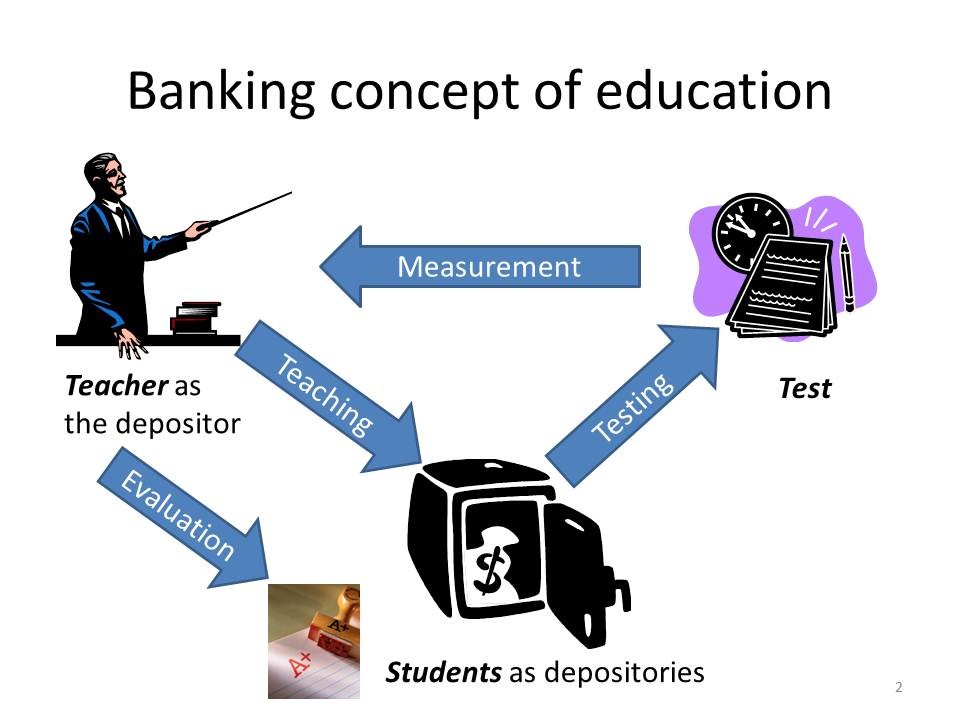
The method of instruction that was used in our elementary school back in the early 1980s closely resembles the banking system that Freirie describes.
We were given the directive to read our textbooks, memorize material, and perform exceptionally well on the summative examinations. We were given the information that a successful learning experience is characterized by high scores and good grades. Our instructors delivered lectures on all of the topics that were covered across all of the subjects, with very little interaction with us, the students. The ideas that were presented as principles and concepts are the ideas that have been reached as a conclusion and are the ideas that we need to accept. These ideas should not be challenged or questioned. This kind of learning only goes in one direction and does not stimulate the learner’s curiosity or intuition. Our generation has most likely been responsible for producing a large number of workers who are process-oriented and obedient, and these individuals have been successfully integrated into our society. Even though it might appear to be a positive development, moving forward will not be possible under these circumstances.
It is essential that we move away from using this method of instruction in our current educational setting, and it is essential that the constructivist educational philosophy be implemented in our classrooms. Students should be encouraged to participate actively in the learning process and interact with one another through the use of collaborative learning. Learning through hands-on experience and going on excursions outside of the classroom are both great ways to inspire students to be curious and motivated. It is essential to make use of various forms of media as well as audio-visual resources in order to consolidate learning and enhance memory retention. The teachers can set up situations in which the students can challenge their assumptions about the material or the teachers. Students will be able to learn more effectively and process information more quickly if their education shifts away from what is known as traditional teaching and toward constructivist teaching and learning.
Photo credit by https://www.happyneuronpro.com/en/info/divided-attention-activities/
Smartphones and other mobile technologies are being utilized in educational settings as well as in homes, with the belief that these devices can enhance human cognitive ability. However, there has been a great deal of research conducted on the three aspects of cognition that are most frequently brought up when discussing the effects of mobile technology, specifically on attention, memory, and the ability to delay gratification. There is also evidence regarding the habits associated with using smartphones and general cognitive functioning. It was also mentioned that using these devices for an extended period of time may have an effect on the user’s ability to think, remember, pay attention, and regulate their emotions.
The current studies in the field today takes a look at the potential cognitive effects of behaviors related to smartphone use. Also, there is growing evidence that there is a significant relationship between the technology of smartphones and one’s cognitive performance; however, there is not enough scientific evidence to support any conclusions that can be made with absolute certainty. The public has a perception that there is a causal relationship between the unrestricted use of multimedia devices among children and the rise in the prevalence of attention deficit hyperactivity disorder (ADHD) in children and teens, which predates the development of smartphone technology (e.g., Visser et al., 2014). Mobile phones are the primary means by which today’s adolescents interact with their peers and pass the significant amounts of time. For younger children, mobile phones and tablets have replaced babysitters and pacifiers as the go-to entertainment options. Because of their increased use at a younger age and greater exposure to smartphones, children and teens are developing shorter attention spans (Nikken and Schols, 2015). The use of these devices on a consistent basis can lower attentional capacity, leading to attention spans that are shorter and tendencies toward “scatterbrained” behaviors (e.g., Egan, 2016).
There is a direct correlation between the effects of using smartphones and attention that is divided or focused in children and teenagers. The ability to ignore other stimuli in order to concentrate intently on a single source is what we mean when we talk about having focused attention. Attention that is focused also includes attention that is sustained, which is the ability to focus for an extended period of time. The ability to divide one’s attention, on the other hand, is synonymous with multitasking skills. The utilization of these tools can at times compromise the aforementioned skills and capabilities. The most difficult obstacle we face right now is figuring out how to take advantage of recent advances in technology without letting that impact our ability to acquire new knowledge.
Vedechkina, M., & Borgonovi, F. (2021). A review of evidence on the role of digital technology in shaping attention and cognitive control in children. Frontiers in Psychology, 12, 611155. https://doi.org/10.3389/fpsyg.2021.611155
Wilmer, H. H., Sherman, L. E., & Chein, J. M. (2017). Smartphones and cognition: A review of research exploring the links between mobile technology habits and cognitive functioning. Frontiers in Psychology, 8, 605. https://doi.org/10.3389/fpsyg.2017.00605








 Learning Together Now